Hertie AI Neural Modeling group at European Retina Meeting (ERM) 2025
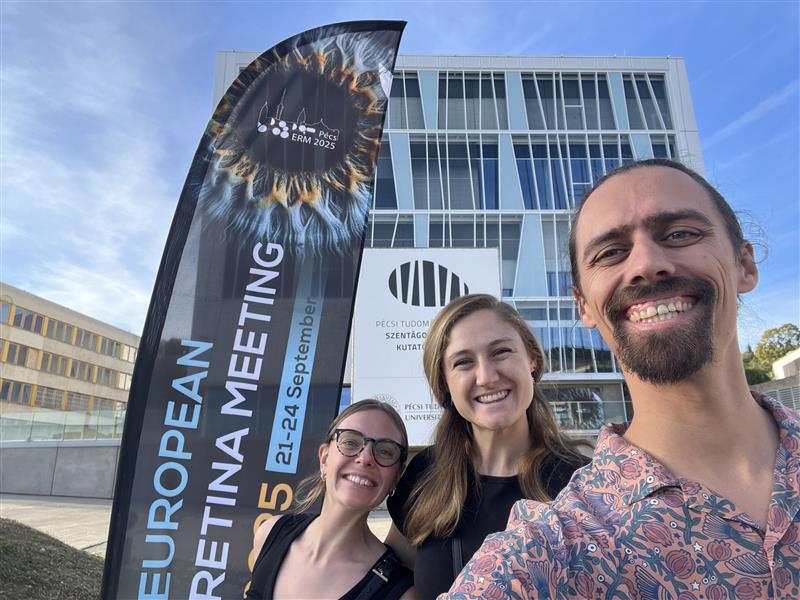
In September, many members of the Hertie AI Neural Modeling group attended the European Retina Meeting (ERM) 2025 in Pecs, Hungary. The ERM is the largest meeting of its kind in Europe, and gathered over 300 scientists from all over the world to discuss their most recent research on the retina --- how exactly does this tiny piece of neural tissue in the back of our eyes turn light into electrical signals, such that later we can see the world around us?
The retina work of our group was represented well by five posters and two talks, organized around our current main topics: Computational models of the retina, and Eyewire II, a large-scale retina connectome project.
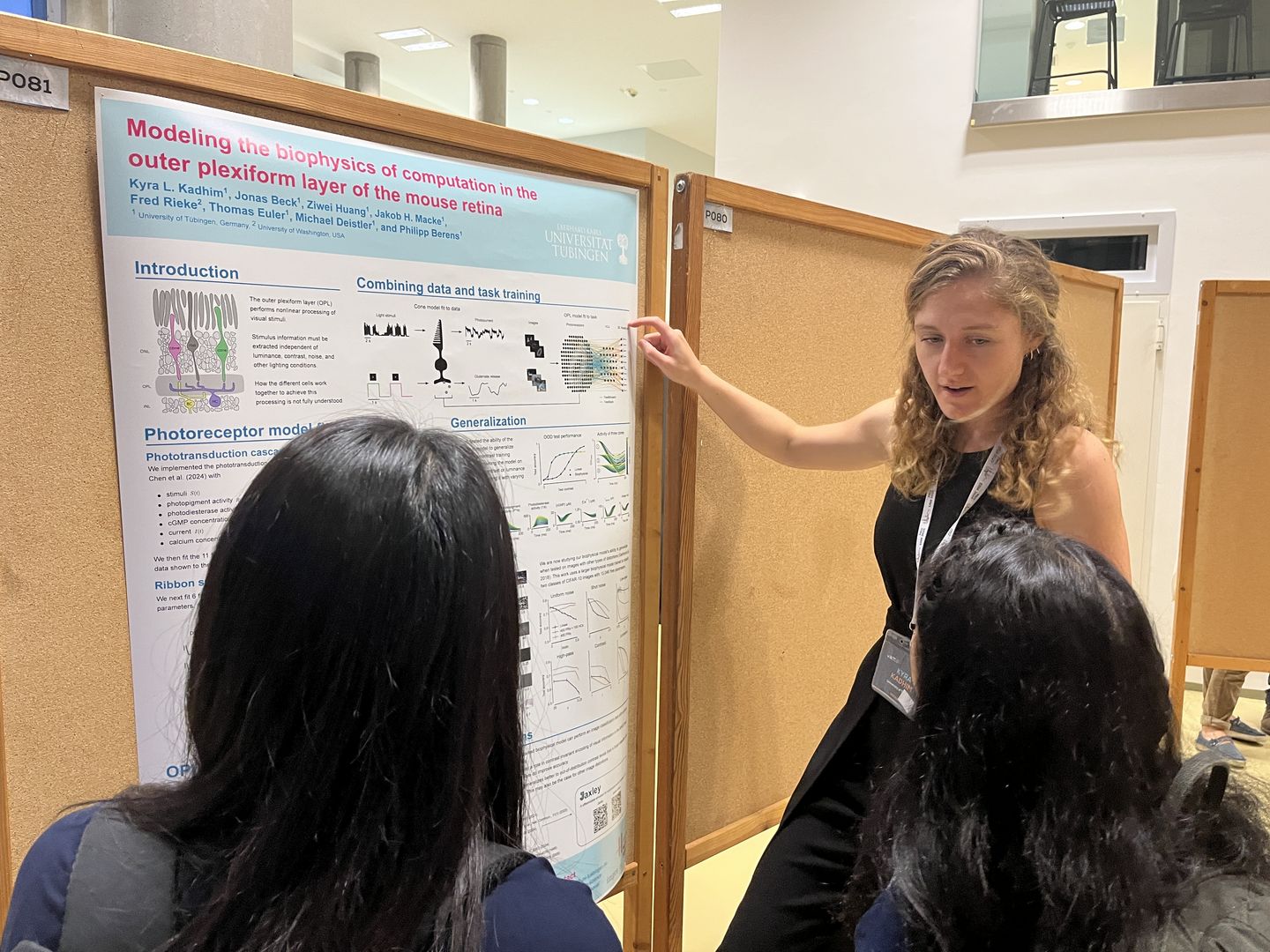
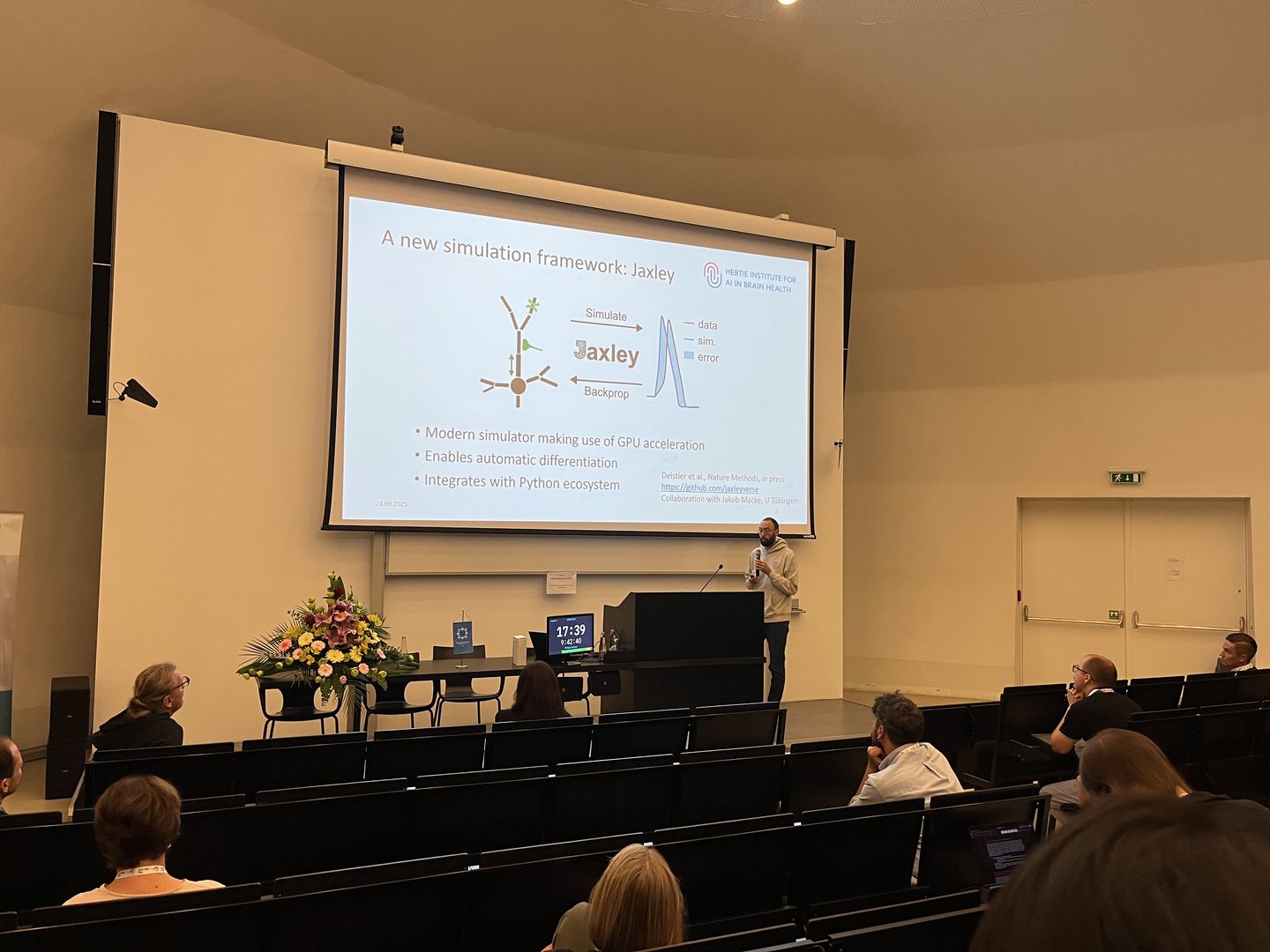
For the modeling part, Philipp Berens gave a talk about different approaches on modeling retina circuits on the computational and the implementation level, highlighting different projects by the group. Some of these projects were also presented as separate posters: Fabio Seel presented his poster on how one can use deep reinforcement learning to study efficient coding in the retina, and Kyra Kadhim showed how she uses biophysical models to unravel the computations in the outer retina.
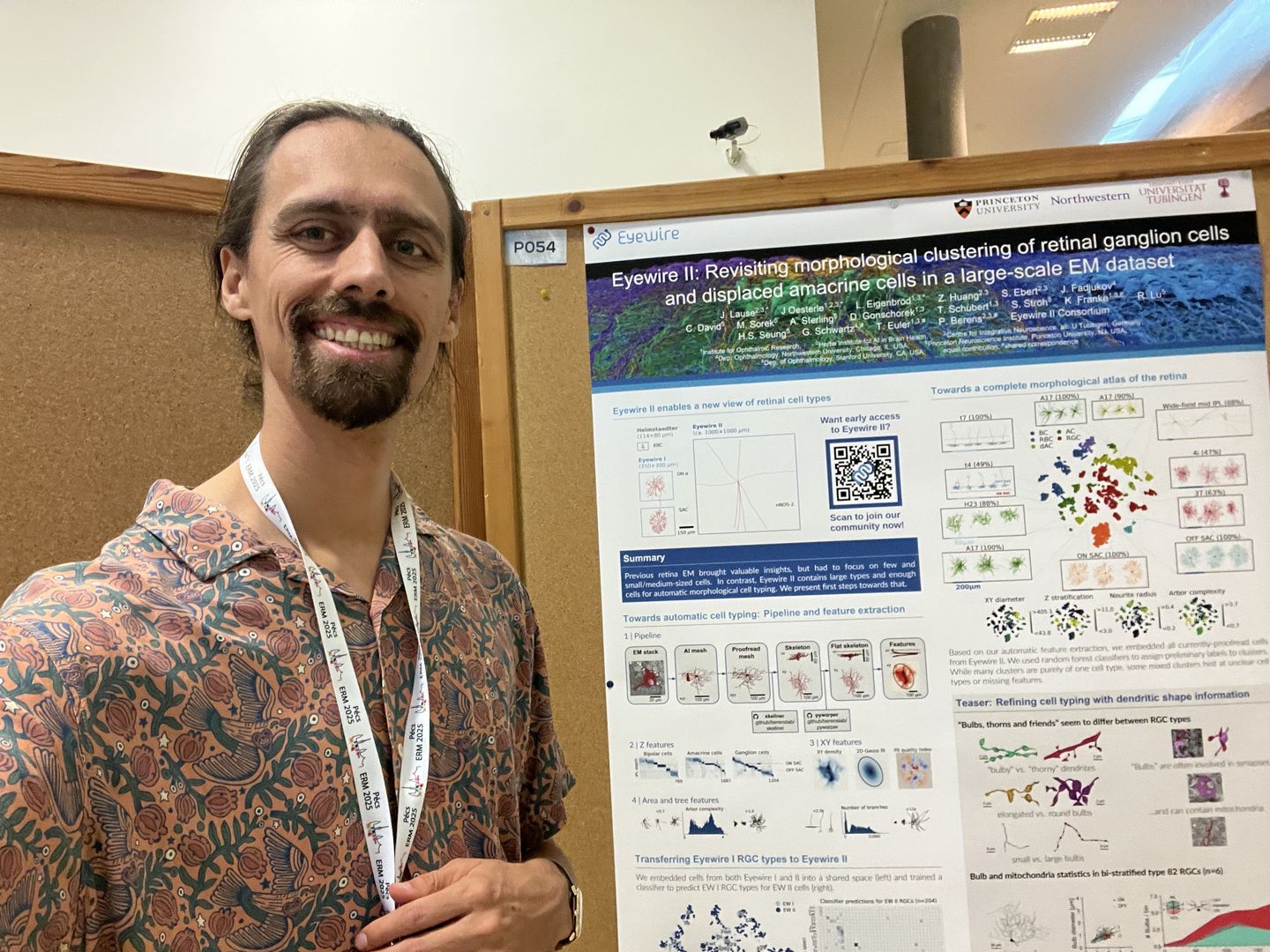
For the connectomics part of our work, we were excited for the first public talk on Eyewire II in Europe: Together with others from the consortium, Jonathan Oesterle co-presented the Eyewire II resource--- an ongoing project that uses electron microscopy and machine learning to produce the largest and most comprehensive wiring plan of the mouse retina. Simone Ebert and myself, also part of the Eyewire II team, presented posters on how the Eyewire II dataset will help our understanding of retinal cell types and their synapses.
The conference was a great opportunity to mingle with researchers from other institutions, and initiate future collaborations. As part of the Eyewire II team --- we work across continents from Japan to California --- it was especially nice for me to see many of my collaborators in person for the first time, and have the chance to pitch the Eyewire II project to many others retina experts and get their feedback. Beyond the scientific sessions, the evening program of the conference included a wine tasting of local Hungarian wines, accompanied by traditional music. We also enjoyed a dinner in the medical faculty with an exciting breakdance performance.
Finally, the travel to ERM itself was also an experience on its own, as many of us took the night train to get to Hungary --- which worked surprisingly well.