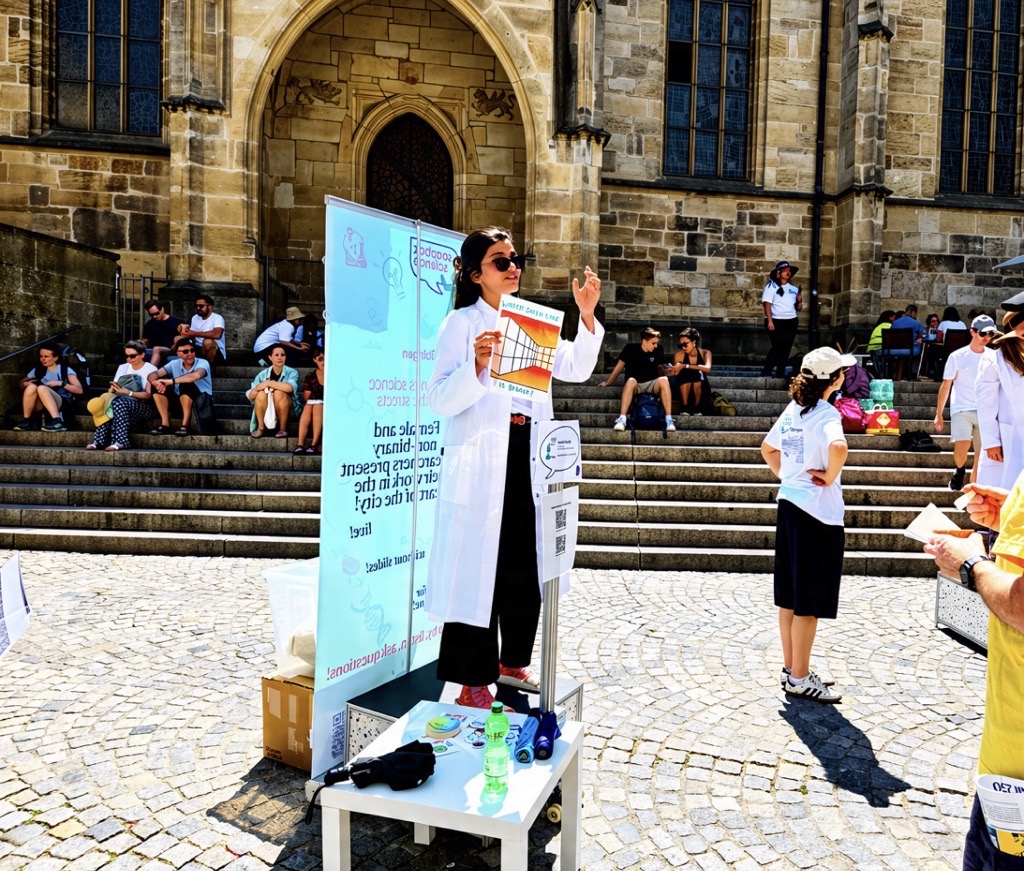
Soapbox Science in Tübingen: "Does AI see the way you do?"
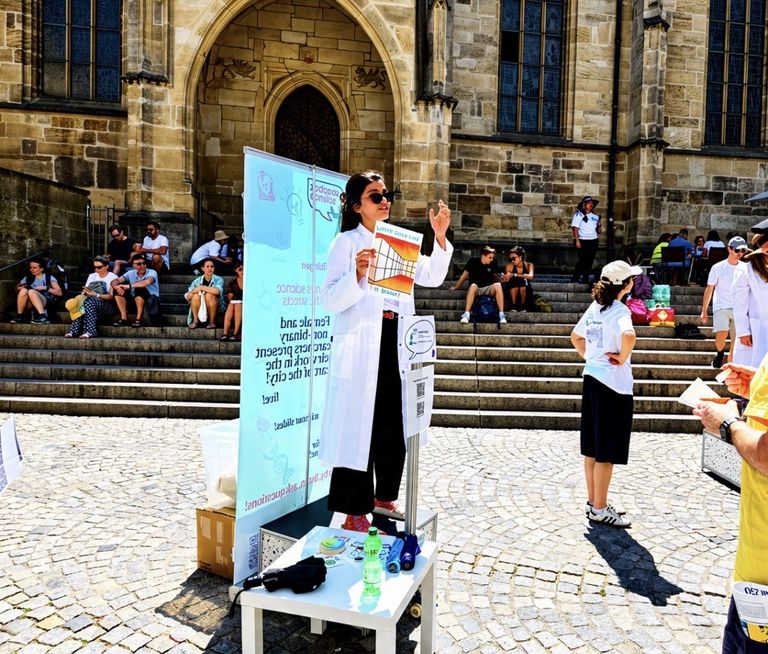
Soapbox Science borrows its format from London's Speakers' Corner: a scientist, a small box to stand on, a public square, and whoever happens to be walking past. These events take place every summer in cities around the world, supporting especially women and non-binary scientists. There is no lecture hall, no slides, no polite applause at the end. Speakers bring props, visual aids and anything interactive enough to make somebody curious and stop walking.
On 11 July 2026, Harini Sudha, PhD student at the Hertie AI, was one of the speakers at the Soapbox Science event in Tübingen. Her topic: "Does AI see the way you do?"
She showed an optical illusion that demonstrates that human vision is not foolproof and adversarial examples: images of objects that are clearly identifiable for humans but artificial intelligence really struggles to classify them. This shows that both humans and machines get fooled, just in very different ways. Harini also walked her audience through a historic neuroscience experiment that inspired the modern architecture of artificial neural networks, showing that human and machine vision are more similar than people think. She closed her presentation with the latest research directions of neuroscience and artificial intelligence: AI as a model to study the brain and taking ideas from the brain to build better AI.
Harini says: "You've only understood a problem sufficiently enough if you can explain a problem to someone with no expertise. People are more than curious to learn, if you are ready to reach their level of understanding."
This year's Tübingen edition was jointly organized by the University of Tübingen, RHET AI, the Cluster of Excellence Machine Learning, and the Max Planck Institute. All speakers went through a workshop beforehand, covering presentation tactics and including practical demos on voice modulation.
Harini would also like to thank the volunteer team, itself mostly women and non-binary, who kept the day running and handed out umbrellas and water to speakers and audience alike in the Tübingen summer heat.
Share article
Author
Harini Sudha J G
 Harini Sudha uses Deep Learning to uncover fundamental principles of retinal perception across species. She is a PhD researcher at the Hertie AI and a member of the ELLIS program. She is particularly interested in how vision systems achieve robustness and adapt to noise, shifting task demands and environmental conditions. She is interested in linking retinal processing with behavioral ecology through explainable computational models for understanding sensory system evolution and diversity. To do so, she explores approaches from Representation Learning and Deep Reinforcement Learning. Through her discoveries, she aims to inform next generation design of robust artificial vision systems.
Images